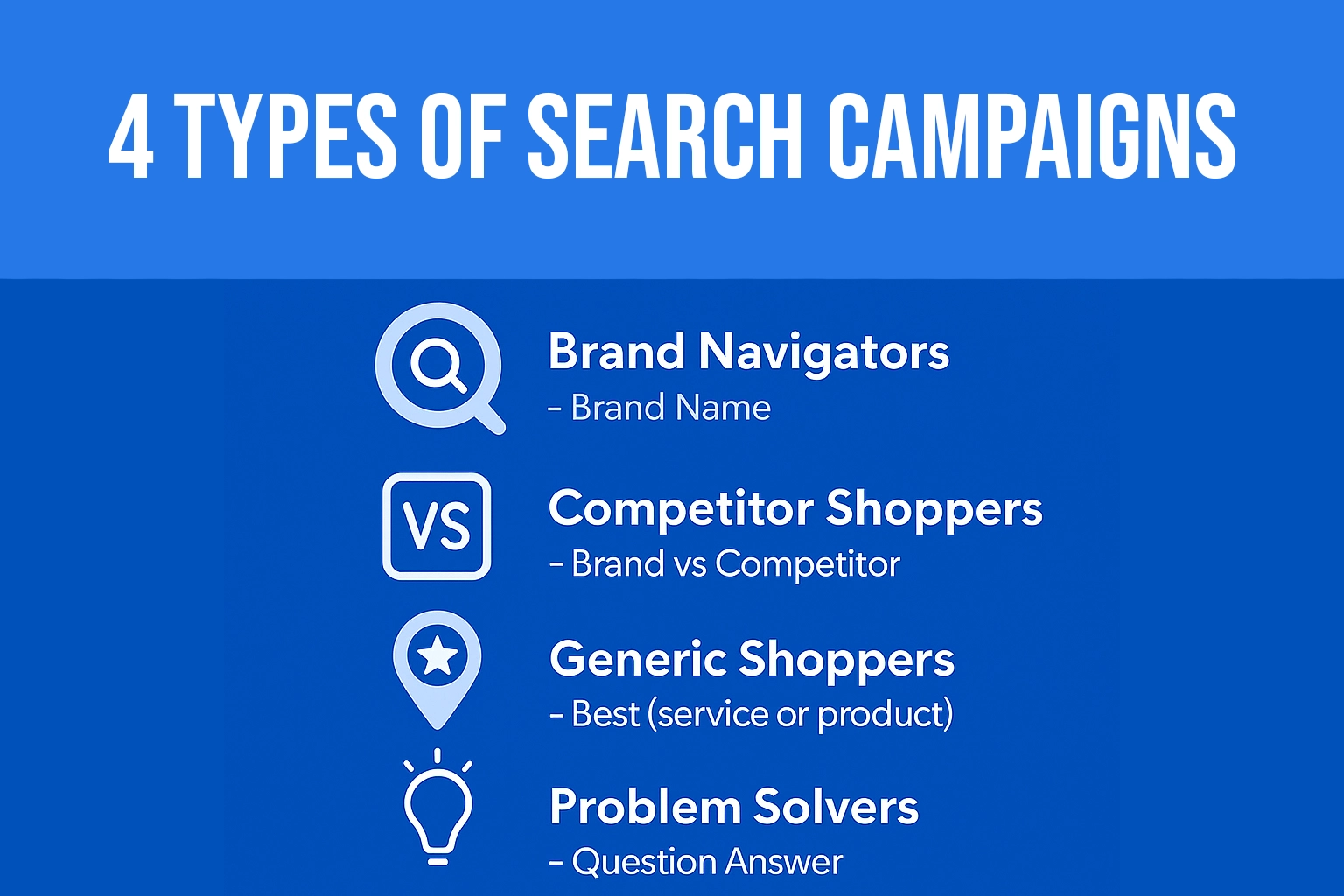
The 4 Types of Search Campaigns Every Business Should Run
At What They Sell, we believe great Google Ads campaigns are built on structure — not guesswork. Every keyword, ad, and budget should play a role in the bigger picture: capturing intent across every stage of the buyer journey. This structure is also one of the biggest differences between beginner, intermediate, and advanced Google Ads Agencies.
Here’s how we structure our search campaigns into four core types that cover it all.
1. What Is a Brand Navigator Campaign?
Brand Navigator campaigns target users already searching for your business by name — like “Puffy Mattress” or “Earthscapes NJ Landscaping.”
Purpose: Protect your brand and convert ready-to-buy customers.
- Defend your brand name from competitor bidding
- Control your messaging at the top of Google
- Capture high-intent traffic from people searching directly for you
Example keywords:
“YourBrand”
“YourBrand reviews”
“YourBrand + location”
These campaigns often deliver the lowest CPCs and highest conversion rates because they reach users who already trust your brand.
2. What Is a Competitor Shopper Campaign?
Competitor Shopper campaigns target people comparing you to other brands — think “Puffy vs Purple” or “Trimble GPS vs Topcon GPS.”
Purpose: Insert your brand into the buying conversation.
- Win attention from buyers in research mode
- Highlight your unique strengths (price, quality, innovation)
- Capture interest from those ready to switch brands
Example keywords:
“YourBrand vs Competitor”
“Competitor alternatives”
“Competitor reviews”
Competitor campaigns help win market share and ensure your business shows up where buying decisions are being made.
3. What Is a Generic Shopper Campaign?
Generic Shopper campaigns reach users searching broadly for your product or service category — not specific brands.
Purpose: Capture new demand from shoppers exploring options.
- Attract new audiences who haven’t chosen a brand
- Build awareness and expand your reach
- Keep your funnel consistently full with new leads
Example keywords:
“Best landscape design company in New Jersey”
“Top laser level for grading”
“Affordable luxury mattress”
Generic campaigns are essential for long-term growth — helping you become a familiar name before customers even know they need you. These campaigns often suffer when accounts are bloated with underperforming inventory.
4. What Is a Problem Solver Campaign?
Problem Solver campaigns answer the questions your customers are already asking. These target pain points and informational searches — before someone even knows which solution or brand to trust.
Purpose: Build authority and trust early in the buying process.
- Position your business as an expert and educator
- Capture early awareness traffic
- Feed remarketing and nurture campaigns
Example keywords:
“Cooling mattress for hot sleepers”
“Why is my backyard flooding after rain”
“How do I know if my site is level for excavation”
Problem Solver campaigns don’t just drive traffic — they build trust and brand recall that pays off later in the funnel. That early stage visibility is also critical for AI driven discovery inside tools like ChatGPT.
Wrapping It Up: The Full-Funnel Search Strategy
When you combine these four campaign types, you create a full-funnel structure that captures users at every stage of intent:
| Campaign Type | Purpose | Example Keyword | Buyer Stage |
|---|---|---|---|
| Brand Navigators | Protect your brand | “YourBrand” | Decision |
| Competitor Shoppers | Win market share | “YourBrand vs Competitor” | Consideration |
| Generic Shoppers | Capture new demand | “Best [product/service] near me” | Interest |
| Problem Solvers | Build authority early | “How to fix [problem]” | Awareness |
Running all four together ensures your business stays visible, credible, and clickable from awareness to purchase.
At What They Sell, we don’t just build campaigns — we build systems that convert searchers into customers. Want to see how these four campaign types could work for your business? Let’s chat and we’ll show you the structure behind every successful Google Ads account.